Following Your First Volleyball Rotation
Following your first volleyball rotation is easier when you track one reference player at a time, so position changes make sense without chasing every rally.
The common mistake when following your first volleyball rotation is trying to watch all six players at once; the cost is a blur of movement just as the pattern begins to make sense. Following your first volleyball rotation is easier if you choose one reference player and track the positions before each serve. That turns a busy court into a sequence you can read one change at a time.
Start with the serve
Watch the team that is about to serve, not the one receiving. In indoor volleyball, that team rotates when it gains the right to serve after the other team’s rally. The players move one place clockwise around the court: the player at the front right goes to the back right, the back-right player moves to back middle, and the sequence continues round the six positions.
The rotation changes the starting order; it does not command players to stay planted in those spots throughout the rally. Once the server has contacted the ball, players may move towards their tactical roles. A middle blocker can head towards the net, for instance, while a setter moves to the position from which they organise the attack. Keep the distinction clear: rotation sets the order, and the team’s next movement sets up the play.
For now, ignore the ball’s flight and pick a player on the serving side. A distinctive shirt, familiar hairstyle or visible number can make a useful reference. Follow that person through the rotation and notice where they begin the next rally.
Map the six places
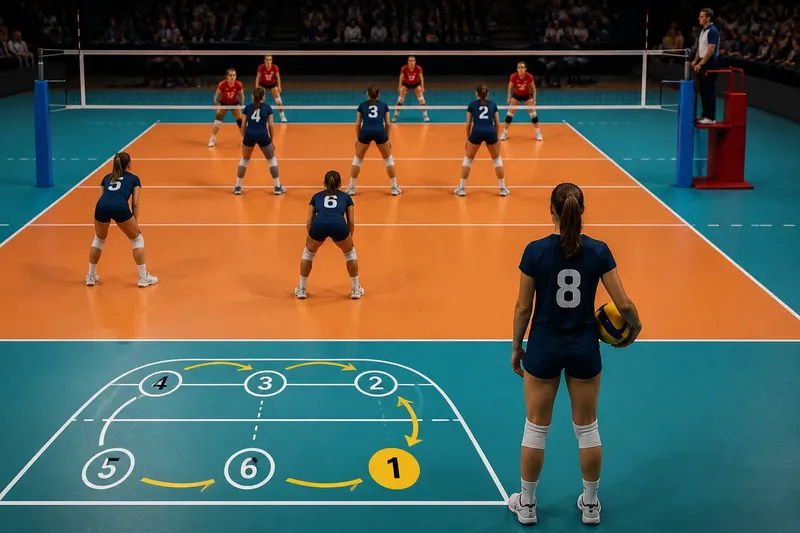
Imagine looking at the court from above, with the net across the top. The three front-row positions sit nearest the net, and the three back-row positions sit behind them. Position numbers are commonly shown like this:
- Front row: position 4 at left, position 3 in the middle and position 2 at right.
- Back row: position 5 at left, position 6 in the middle and position 1 at right.
Position 1 is the service position, and the clockwise order runs from 1 to 6 and then back to 1. If you prefer not to memorise a diagram, use the server as your anchor: the player serving from back right occupies position 1. The next place clockwise is position 6, at back middle; position 2 is at front right, beside the net.
Do not assume that a player’s usual job tells you their current rotation position. A setter or outside hitter may begin in a spot that looks unexpected, then move once the serve is underway. Rotation is about where players are ordered at the moment of service, not simply the role they perform during the rally.
Watch the service change
When the receiving team wins the rally, it earns the right to serve and rotates before the next serve. The team that was serving stays in its current rotation order if it wins the rally and serves again. A rotation is not triggered after every point; it happens when a team takes over the serve from its opponent.
Use the pause between rallies to check who now stands at the back-right service position. If the receiving team has just gained the serve, look for its players to shift one place clockwise. If the serving team keeps the serve, expect the same rotation order at the next service, even though players may have moved around during the previous rally.
Say you are watching a team whose number 8 is serving from back right. The opponents win the rally, so number 8’s team must receive and rotate. Number 8 moves from position 1 to position 6, back middle; the player at front left, position 4, moves to position 1 at back right and serves next. At the following service change, you can check whether number 8 has moved on to the next place in the same clockwise sequence, rather than trying to identify every player’s role.
Follow one player
Choose a player whose movement is easy to see and make a small mental note of their starting place. On the next rotation, predict the next spot clockwise before checking the court. That prediction gives your eyes a simple task during the reset, while you can watch the rally normally.
A player’s number can help, but only if it is visible. If bodies overlap or the camera cuts to the bench, switch to a stable visual cue such as the player’s place in the front or back row. Avoid following the ball as your only guide: it tells you where the rally is happening, not where each player sits in the service order.
Once the first reference player feels familiar, add one neighbour in the rotation. For example, if your anchor is at back middle, notice who occupies back right. You now have a simple pair to compare after a service change without turning the whole court into a memory test.
Separate order from movement
After the server contacts the ball, players often move quickly to their preferred positions. A player who began at front right may cross towards the middle, and a back-row player may shift towards the sideline. Those movements are part of the team’s arrangement for the rally; they do not mean that the clockwise rotation has happened again.
A useful viewing sequence is to identify the service order before the ball is served, watch the rally without trying to label every movement, then check the new order only if the right to serve changes. This keeps rotation from swallowing the action. You can enjoy a long rally and still return to the same reference player when play stops.
In some matches, a libero wears a contrasting shirt and replaces a back-row player under the rules of the competition. That can make the court look as though an extra player has entered the rotation. Treat the libero’s appearance as a separate substitution pattern for now; keep your reference on the player whose place in the six-player service order you have been tracking.
What should you watch next?
When does a team rotate?
A team rotates when it receives the right to serve after its opponent served. A team that wins a rally while already serving keeps its order for the next serve.
Which way do players rotate?
Players move one place clockwise around the six positions before their team serves. The player moving into back right takes the next service, while the others advance to neighbouring spots.
Do players stay in their rotation spots?
No. Their positions establish the serving order, but after the server contacts the ball they can move towards their roles for that rally. Watch the reset before service to read the rotation, then watch the play.
Why does the lineup sometimes look different?
Teams may use substitutions, and a libero may replace a back-row player under the competition’s rules. Match regulations and officials determine the permitted details, so use the displayed lineup or commentary if a change is unclear.
Build a viewing rhythm
At your next match, start with three checks: find the serving team, locate the server at back right and identify one player to follow. After each rally, ask whether the right to serve changed. If it did, look for the clockwise shift; if it did not, let the starting order stand.
When that feels comfortable, use the rotation to anticipate who might serve next and which players are in the front row. You do not need to predict the attack or decode every tactical choice. A clear sense of the service order is enough to make lineup changes feel deliberate rather than random.
Following your first volleyball rotation is ultimately a matter of choosing what not to track. Let the ball have the rally, let the players take their tactical routes, and reserve your attention for the quiet moment before the next serve. That brief reset is where the court’s underlying order becomes easiest to see.