What a Football Formation Number Can—and Can’t—Tell You
A football formation number offers a useful starting picture, not fixed job descriptions. Learn to spot the role changes that reveal a team’s shape in motion.
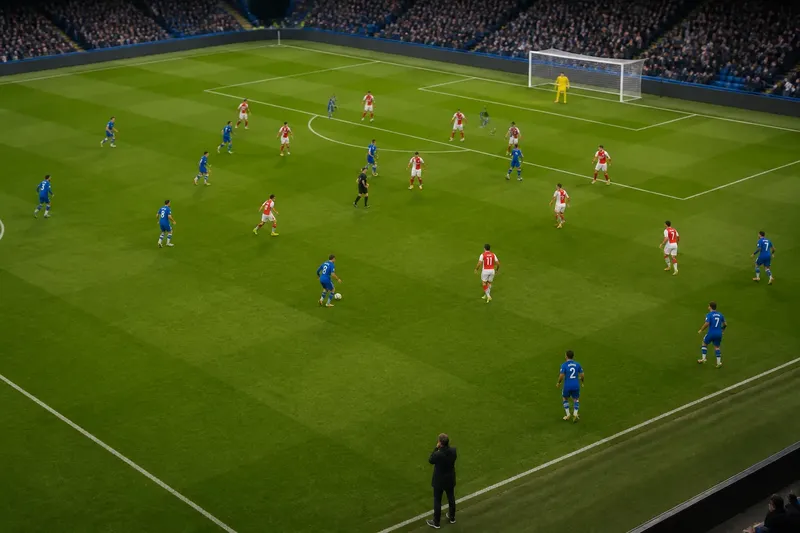
The most common mistake in reading a football formation is treating its number as a row of permanent job descriptions. A football formation number is a starting picture: mistake it for the whole match and you can miss the movement that explains how a team actually plays.
A side listed as 4-3-3 might defend with four across the back, then look like a 3-2-5 when it has the ball. The label gives you a useful first clue, not a promise that every player will stay in one lane. To watch well, follow the roles as they change.
What the number shows
Formation numbers usually count outfield players by their broad starting lines, from defence towards attack. In a 4-3-3, the first four are defenders, the middle three midfielders and the front three attackers. The goalkeeper is not included.
That shorthand helps you recognise the initial arrangement and compare broad choices: a team with three central defenders begins differently from one with four, for instance. But the number cannot tell you exactly how wide the wingers stand, which midfielder advances, or what happens when possession changes hands.
Nor is there one universal way to write every shape. A 4-2-3-1 and a 4-4-1-1 may describe similar starting positions with different emphasis, while match graphics can simplify what the coach has asked players to do. Treat the label as a map legend, not the terrain.
Three ways to read it
There are three useful approaches, depending on what you want to notice. None requires memorising every tactical term; each shifts attention from the printed number to a different moment in play.
Read the starting shape
Use the listed formation as an entry point. Look for the broad lines and ask how many players begin centrally, how many offer width, and where the forwards are positioned. This suits a new viewer or anyone comparing the teams before kick-off: the arrangement gives you a quick sense of the plan’s starting ingredients.
Its limit is that it can freeze the players in place in your mind. A nominal wide forward may spend much of the match inside, while a full-back takes the outside lane. The starting shape helps you identify the cast, but not their full set of roles.
Track one player
Choose a player whose job appears likely to change, such as a full-back, a holding midfielder or a forward who drops towards the ball. Follow them across several phases: where do they stand when their team builds from the back, where do they move after a pass, and what do they do when possession is lost?
This approach suits a viewer who wants to understand how one role connects the team’s phases. It also avoids the blur of trying to watch all twenty outfield players at once. Its trade-off is that you may miss what the player’s movement creates elsewhere, so occasionally widen your gaze to see who fills the space they leave.
Read the team’s shape in motion
Instead of following one person, pause your attention at a few moments: when the goalkeeper starts an attack, when the ball reaches the final third, and when the other team has settled into possession. Notice how many players occupy each line and which lanes are left open or filled.
This suits viewers who enjoy tactical patterns and want to compare a team’s attacking and defensive organisation. It is harder to do during a fast passage of play, and the picture can shift again after a substitution or a change in the score. Think in phases rather than searching for one definitive shape.
Roles in motion
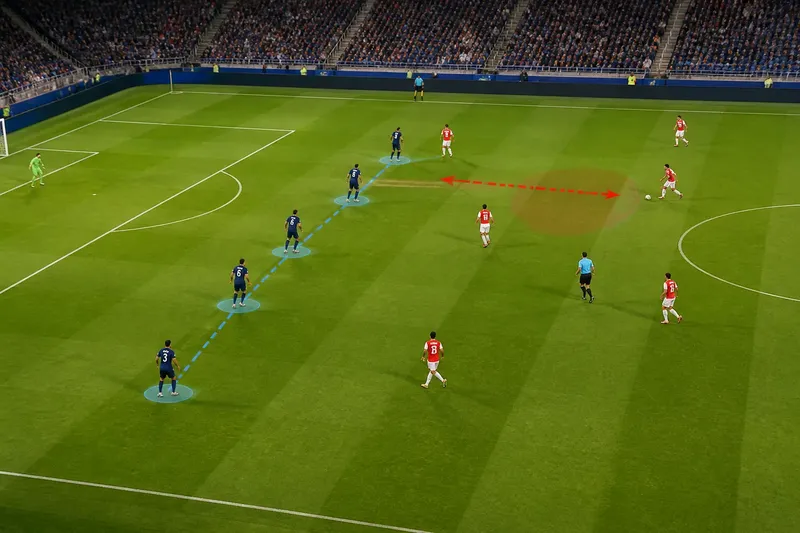
A player’s role often changes because a teammate moves. If a full-back advances to provide width, a winger may move infield. A central midfielder can drop closer to the defenders to help start play, while another midfielder pushes forward. The team has not necessarily abandoned its formation; it has rearranged its responsibilities for that moment.
Imagine a team shown as 4-3-3. When it has the ball, one full-back stays near the centre-backs while the other runs up the touchline; a midfielder drops beside the back line, and the winger on that flank moves inside. You might now see three players protecting the space behind, two offering support in midfield and several occupying attacking lanes. When possession turns over, those players recover or press, and the original picture changes again. The observable clue is not the label but who occupies the vacated spaces.
This is why a formation number can be accurate and still feel misleading. It describes a recognisable arrangement, while the match asks players to react to the ball, opponents and teammates. A role is better understood as a set of responsibilities in a particular phase than as a fixed square on a diagram.
Choose your viewing lens
Pick the approach that matches the question you want answered. If you are learning the teams, begin with the starting shape. If one player’s decisions interest you, track that player. If you want to understand the collective plan, compare the team’s positions across phases.
- For a quick preview: Check whether a starting formation is shown; if it is, use it to identify broad lines, but if it is absent, watch the first settled restart for the initial arrangement.
- For a player’s role: Check whether the player changes lanes as the ball moves; if they do, follow who fills the space, but if they stay in one area, watch how they support nearby teammates.
- For a team’s attacking shape: Check the positions when the side has controlled possession; if players occupy different lanes from their starting lines, note the shift, but if the picture is unclear, wait for another settled attack.
- For the defensive shape: Check where players stand after the opponent establishes possession; if they form recognisable lines, compare those with the attacking arrangement, but if they press high, track which spaces they leave behind.
- After a substitution: Check which player takes the departing player’s area; if the team keeps similar lines, the change may be role-for-role, but if positions shift, reassess the shape rather than relying on the old label.
- After possession changes: Check who presses and who retreats; if players recover into lines, read the settled defensive shape, but if they chase the ball, wait until the next pause to see the structure clearly.
These lenses work best as alternatives for a stretch of the match, not as tasks to juggle every second. A short reset at a goal kick, throw-in or other pause gives you a clean moment to see where players are arranging themselves.
Questions about formations?
Does a formation stay the same all match?
Usually, the starting label does not describe every phase. Teams can shift their positions during possession, while defending, and after a change in personnel or approach.
Why do two teams with the same number look different?
The number leaves out details such as player spacing, movement and individual responsibilities. Two 4-3-3 sides can use their wide players or midfielders in very different ways.
Can a player have more than one role?
Yes. A player might help build attacks in one phase and defend a different area when possession changes. Their task depends on the situation and the team’s plan.
Which formation should I look for first?
Start with the formation shown before kick-off, if one is provided, and treat it as a rough guide. Then check what players actually do once the ball moves.
Read beyond the label
The football formation number is useful when it starts a question rather than ends one. Once you have spotted the opening arrangement, look for the role changes: who moves wide, who fills the middle, and who stays ready behind the attack.
Say you see a 4-3-3 graphic before kick-off, then notice the right-back advancing while the right winger moves inside. Your starting answer is that the team’s listed shape is 4-3-3; your next observation is that its right side changes roles in possession. That distinction lets you describe both the plan’s opening picture and the shape developing in front of you.
Next time a broadcast graphic names a formation, use it as your first clue, then watch the players redraw it.