Why a Defensive Line Steps Forward Together
Why a defensive line steps forward together: learn how the move squeezes passing space, changes attackers’ options and becomes risky when defenders lose shape.
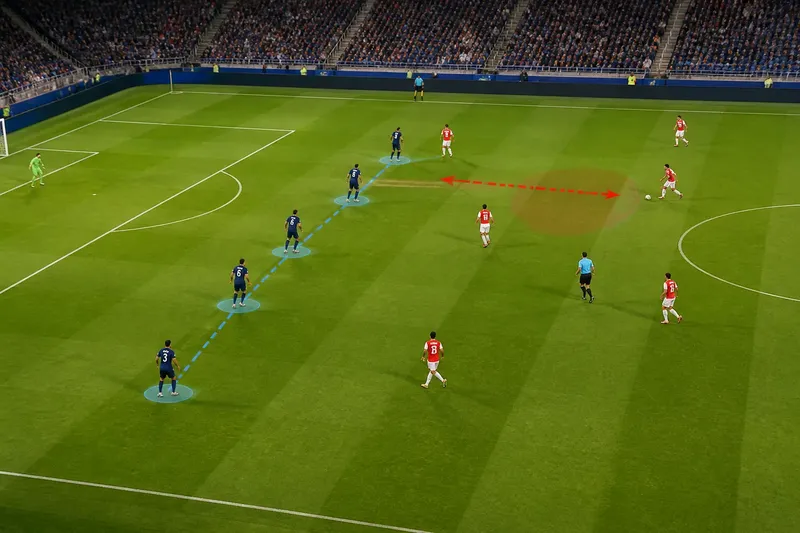
The common mistake in reading a defensive line is to treat a forward step as a chase. If defenders rush towards the ball one by one, gaps can open behind them and give the attack a route through. In football, a defensive line steps forward together to reduce the room attackers can use, not simply to get closer.
Space behind the line
When defenders hold a deep position, an attacker between the lines may have time to receive, turn and pick a pass. A coordinated step shortens that pocket of space. The receiver may have to play backwards, pass quickly or take a touch under pressure instead of facing forward with time to choose.
The move can make the pitch feel smaller to the team in possession. If the defenders advance while staying connected, they reduce the distance between the back line and midfield. Short combinations become harder, and comfortable passing lanes through the centre may disappear.
But the space has not vanished; it has shifted. A step forward leaves more room behind the defenders, where an attacker can run onto a through ball. The line is making a tactical trade: less space in front, more space at its back. The outcome depends on timing, pressure on the passer and the attackers’ positions.
When the line splits
A line compresses space only when its defenders move in relation to one another. If one centre-back advances while a full-back stays deep, the defence becomes staggered. An attacker may find a pocket between the positions or time a run from the deeper defender’s side.
Players can react to different cues: one watches the ball, another tracks a runner, and a third hesitates because a pass looks imminent. Their individual decisions may seem sensible, but together they can leave a gap to receive in or a channel to sprint into.
Watch the defenders’ shoulders and spacing, not just their distance from the ball. If the back line moves in a clean, shared direction, it is trying to compress the field. If a player is clearly left behind, the team may be exposed until the line resets or a teammate covers.
When the passer has time
A high line is more vulnerable when the player with the ball has time to look up and choose a pass. With little pressure, an attacker can spot a run and send the ball over or between defenders. A forward step without pressure on the passer can shrink one area while leaving a clear target behind.
Defenders often judge their step alongside pressure from teammates. If a forward closes down the ball-carrier and limits their time, the back line may feel able to advance. If the ball-carrier is free to set their body and scan, defenders may instead drop, hold their shape or delay the step.
Say you are watching a match and an opposing centre-back receives the ball with no nearby pressure. Your team’s defenders begin moving up, but the passer still has time to look towards a runner. Watch whether a teammate closes the passer and whether the defenders keep moving together. Without pressure or coordination, the run behind may become the easier option.
When the flag changes the picture
Stepping forward can leave an attacker beyond the defenders when a pass is played. The offside rule can restrict an attacker’s involvement in such a position, so a team may use a coordinated advance to compress space and make some forward runs harder to exploit. That does not make every run offside or make the defensive move safe.
Attackers can time their movement to stay level with the defenders, and a pass may be played before the line moves. A defender who is late, distracted or positioned deeper than teammates can also keep an attacker onside. The assistant referee’s flag is one part of the match picture, not proof that every forward step worked as intended.
Compare the moment the pass is played with the positions of the attacker and defenders. Then notice whether the attack had a usable route even if no pass was completed. The line may have forced the ball wide, discouraged a run or hurried a pass; those effects matter without an offside call.
Reading the next move
Why do defenders step up?
They are often trying to reduce the space between defence and midfield, making it harder for attackers to receive and turn. The advance can also support pressure on the ball, provided teammates move together.
Does a high line always mean a trap?
No. A line may advance to squeeze the playing area or follow the team’s movement without relying on an offside call. Watch how defenders respond to the pass and the runners before deciding what the team is attempting.
What makes the move risky?
A free passer, a mistimed step or a defender who stays behind can open space for a run or pass through the back line. The more time the attack has to spot that opening, the harder it can be for defenders to recover their shape.
What should I watch after the step?
Check whether the receiver is forced backwards or crowded, and whether an attacker can run into the space behind. Those clues show what the advance offered and what it conceded, even when it does not lead directly to a tackle or chance.
When the advance fails
A coordinated step is a choice, not a promise of success. A precise pass, a well-timed run or a defender who cannot follow the movement may defeat it. The attack may also choose a safer pass elsewhere, meaning the line has reduced one option without winning the ball.
When the move appears to break down, trace the sequence rather than blaming the highest defender. Ask whether the passer had time, whether the line was connected and whether the attackers had already started moving behind it. That makes the tactical purpose clearer: a defensive line steps forward together to compress the space in front while accepting that the space behind becomes more valuable. The next useful clue is who can reach that space first—and whether the ball-carrier has time to find them.